

Attention is the new currency for PC Gaming
How AI is going to destroy and rebuild the game industry
from  Stardock Forums
Stardock Forums
This Labor Day I was finally able to stop and take a breath about how AI is going to affect the game industry.
Like many of you, I feel like AI news, content, and hype have permeated every aspect of my work and personal life. It's been relentless. And it's moving faster and faster. Is it overhyped? Maybe. But I think it's going to accelerate the death spiral of many game studios.
Below is a chart from the GitHub blog
Around December of 2025, a threshold was crossed: AI reached the point where it's better than most software developers, and the results have been predictable: Everyone can create "software" or something that looks a lot like it.
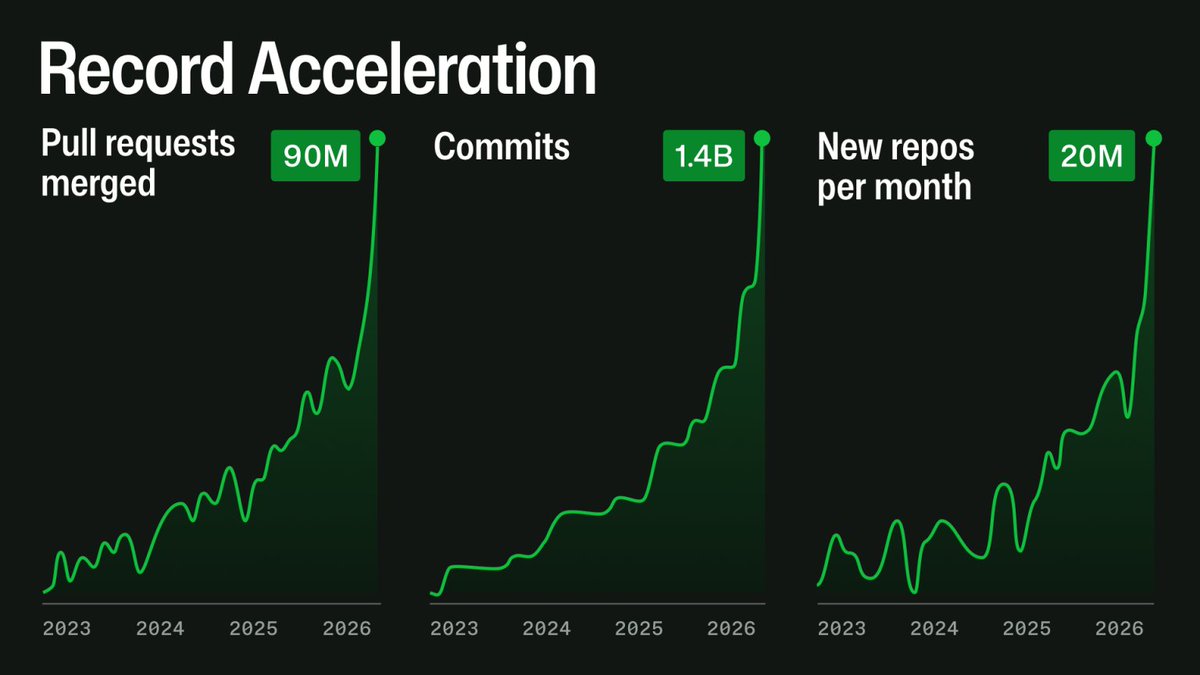
Github is the canary in the coal mine. There is no barrier to entry to put an app on Github. The next obvious explosion of new content is going to be on Steam.
Here is what we are looking at.
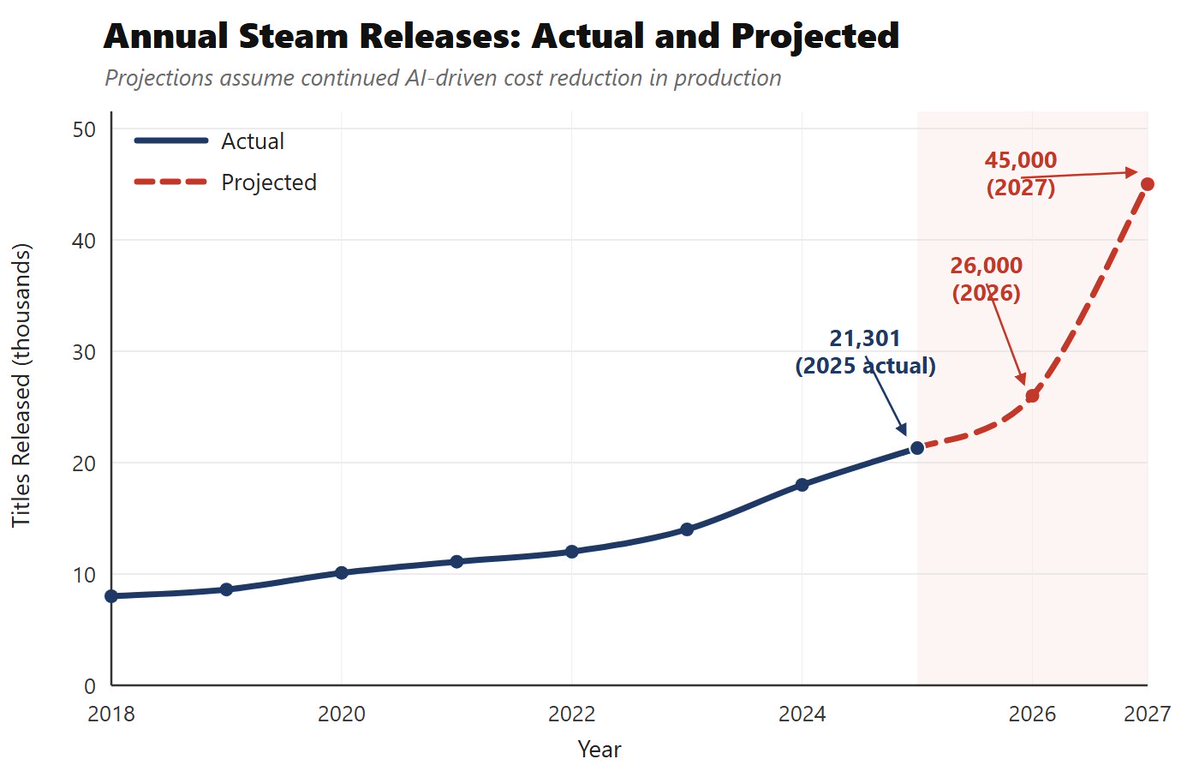
Now, this assumes no changes to policies on Steam. I could (and hope) for a scenario where endless low effort AI slop gets gated but that's a pretty significant burden to put on Valve. What determines "low effort AI slop"? Regardless, we're going to see an explosion of new titles on Steam that accelerates the trend we have already seen.
Three Numbers
There are three numbers we pay attention to:
-
The number of titles released
-
The number of titles that the market can realistically be paid attention to.
-
What percentile of the attention your game has to get to be successful As you will see in a moment, it'll be obvious why the AAA studios are already struggling.Now, all three of these numbers are known.
-
The first is public knowledge. You can look up how many game get released on Steam.
-
The second number is calculated by a well understood principle that goes by many names but we will use the square root attention curve. This is roughly how many of a given thing can get a reasonable amount of attention.
-
The third is just dividing the second by the first.
There is also the Pareto distribution, broadly known as the 80/20 rule. A small group of things will get the vast majority of stuff.
Let's test it out with small numbers. You have 10 games. The square root of them is about 3. 3/10 = 30% of the games will get enough attention to make 80% of the profit and the other 7 games will fight over the last 20%. This isn't new and is well understood across every industry.
This formula works no matter the size of the set of things. It even works on things like words, letters, wealth distribution, pretty much anything. It's pretty weird actually.
Putting the numbers in perspective
So let's go back in time. The year is 2014. 1,700 games are released on Steam. That's the year Galactic Civilizations III went up on Steam. That year, 1,700 games were released on Steam. We only needed to be in the top 2.5% of games released that year to get most of the attention. And we did. It was great.
A year later, w. We released Ashes of the Singularity and Offworld Trading Company and the situation had already gotten a lot tougher. The games both finished in the top 2.5% also but the situation had changed.
Because that year 4,600 games were released. Now you had to be in the top 1.5%. Top 2.5% didn't make the cut now. As a result, neither did anywhere near as well as Galactic Civilizations III.
Now, the big studios, they are designed to be in the top 1%. ou might even say their entire business model was predicated on being in that top 1%.
Make a good game, use existing distribution and marketing clout and it was a pretty safe bet.
Covid
Covid is what ultimately killed the game industry as we know it. While 10,000 games were released in 2020, being just outside the top 1.0% of games was still viable because of the temporarily inflated size of the overall pie. But the costs of games skyrocketed due to decision makers only looking at the overall size of the pie and not understanding that the pie was going to be eaten almost exclusively by that top 1.0%.
Now let's go to last year. 2025
21,000 games were released on Steam. The pie size had returned to what you'd expect and you have to be in the top 0.70% of games.
A solid game and a GameCom visit and a Video Game Awards announcement isn't enough. Combine that with the cost increases and you have a serious problem. Try it for yourself right now.
Can you name 5 games that were featured at GamesCom? It was only a month ago. We only have finite attention to give. And so many things are competing for that attention. And to drive the point home, I can name 5 games from 1997 that you probably know of too.
-
Golden Eye
-
Fallout
-
Grand Theft Auto (the original)
-
Age of Empires
-
Ultima Online And as a bonus, the greatest game made in human history by the God King Chris Taylor, Total Annihilation.
But in 1997 there were only ~400 games released that year. That means 1 out of 20 games released that year was a hit (sorry Stardock, Entrepreneur and Links Golf for OS/2 didn't make the cut and our StarCraft expansion wouldn't be released until 1998.) But the crazy thing was that those games still did pretty well for us because while the pie has grown massively since 1997 I'm not sure it's grown by a factor of 50.
The Coming AI Deluge
So what happens when there's 40,000 games released a year? As I mentioned, attention is well understood in terms of how many things people can pay attention to.
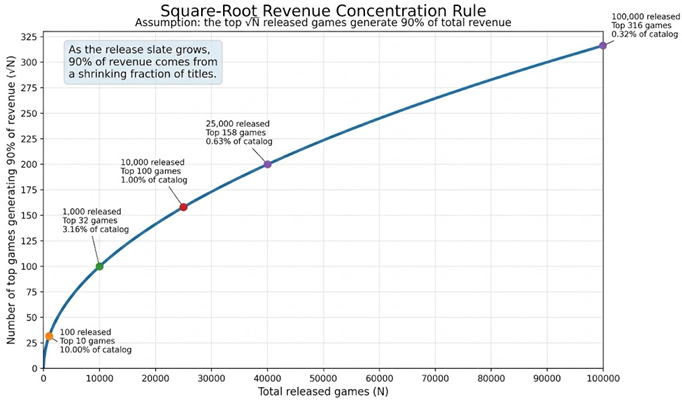
The square root of 40,000 is only 200.
So 200 make most of revenue and the other 39,800 fight over the last 20%? Right? That's a scary situation. But it's actually a lot worse than that because I've been leaving out another factor that's changed since 2014.
Games are no longer competing against just new releases. They are competing against every game that has ever been made. So it's not 40,000. It's It's 40,000 + all the other games on Steam. There's about 100,000 titles on Steam. Only the top 0.3% of them will get paid attention to.
And this discounts the attention give to other platforms that have exploded since 2014 like Roblox, emulation, MiSTer, mobile, back catalogs released on consoles, etc.
What's your backlog?
This is a safe place, you can share it in the comments. Attention now matters so much more than any other consideration. Any game that has ever gotten attention has a massive advantage over the new IP that now has extremely low odds of winning some.
The Game Industry is dead, long live the game industry
What I've written here is already known by executives at the major studios and publishers. You can see it in their actions. The vast majority of large game studios are going to be going away in the next couple of years. There is nothing that can be done. They were built on a model that no longer exists.
On July 6, Xbox CEO Asha Sharma reported that for every $100 they invested they only saw $36 back. Think about that.
The business model that was built on the assumption that if you did A, B, and C that you could make a 30% margin because your new game would be in the top 1% of title sales that year is now gone.
So what is going to happen?
Let me walk you through what is going to happen over the next 36 months: The big IP holders are going to start licensing their titles to the next-generation of game studios. These will be tiny independent studios around the world and they will mostly use AI. Not so much for the art (one of the big ironies is that writers and artist are much safer than us poor engineers and producers) but for the overall production.
Using Clairvoyance, I could make Galactic Civilizations III, but much better, by myself, in about a year. I'd contract the art and can do the writing myself (my favorite part). Now, get a little more than a half dozen people armed with it and you can output some amazing stuff.
So what's going to happen is that any IP that has reasonable attention, especially classic games, is going to be very valuable. They will get licensed. This isn't a new concept but the risk/reward ratio has drastically changed.
The flagship franchises won't be handled this way but think of all your favorite games from the past that would benefit from a AAA quality make over. Because they already have some attention to start with it's purely a matter of cost.
As someone who has developed a lot of new IP over the years, this trend doesn't exactly make me excited...
...on the other hand, I do look forward to the remake of Mail Order Monsters.
 Stardock.net Forums