Experimental Creationism

Creating life out of thin air using the handy tool of creation

To make Creationism a science, you'd have to start with some experiments.

Have there ever been successful lab experiments demonstrating how a god creates life (let alone two different lifeforms)?

You need:

1. A lab without any life in it.

2. A big or mid-sized all-powerful god. (You can use a Greek or Roman god or a Semitic god, I don't care; please refrain from using Hindu or native American gods if possible to make the experiment easier to reproduce. Darwinists use fruit flies because they are easily obtained and well-understood. But I don't know much about Hindu gods.)

3. A way to observe the process of creation. You can use a camera and I will happily believe that you will refrain from using camera tricks. (A man dressed like Zeus comes in and blinks and in the next scene there are 20 fruit flies flying around his head. If that happens I will assume it was not a camera trick if you tell me it wasn't.)

I can probably help you with the lab (i.e. point you to a local university), but obtaining the god can be somewhat difficult. For me it would be, since I don't believe that Creationism is science. For someone who knows that Creationism is science, obtaining the necessary gods for casual experiments is probably as easy a task as obtaining fruit flies is for those scientists who see a difference between Creationism and science.

6,449 views 22 replies
Reply #1 Top

Experimental Creationism

I think this simple experiment should be taught in science class.

Students can then decide for themselves whether they think that life has been created in the same way (and as sucessfully) as shown in the experiment (just several thousand years earlier) or whether life has evolved in the same process as in the fruit fly experiment (just over longer time and with many more tiny changes).

I finally found a way to unite Christianity and Existentialism!

Reply #2 Top
I finally found a way to unite Christianity and Existentialism!
End of quote


Hey, Kierkegaard did it almost 200 years ago, but I won't deny that I love the idea of the experiment. ;)
Reply #3 Top

mid-sized all-powerful god
End of quote


Hahahahaha.

Reply #4 Top

Hehe...

Article tags are "fairy tales" and "religion" and Google chose a Scientology ad for it! :-)


Reply #5 Top

Incidentally, for the last few months I have been getting lots of spam from Scientology (signed by them) to my gmail account in Hebrew!

It was something about "it starts in the head" with pictures of Einstein. It's very pro-Isral but nevertheless deeply disturbing and ridiculous.

Reply #6 Top

ok to be fair you need

1.  A lab with no life in it.

2.  No God

3.  A way to observe the process.  You can use a camera or a video camera.

Good Luck!  You're going to need it.

Thank God we creationists have God. 


Reply #7 Top

ok to be fair you need

1. A lab with no life in it.

2. No God

3. A way to observe the process. You can use a camera or a video camera.

Good Luck! You're going to need it.
End of quote


What would that experiment show? Atheistic Creation? Don't tell me you want to teach another "theory" which cannot be demonstrated in an experiment!


Thank God we creationists have God.
End of quote


Really? So bring your god on then.

Evolution says that animals can change over time through natural selection. You can observe the process in a lab.

I don't know what your no life/no god experiment would be good for. Seems to me you can show neither evolution nor Creation using that experiment. (Perhaps you are now an adherent of atheistic Creationism? Things just start to exist without any cause at all? Still not a science.)

You know what? I think your "Christian principle" of "honesty" has compelled you again to pretend that you were never told that evolution is not about creating anything out of nothing. Fine thing that "Christian principle" of "honesty". Very useful in discussions, isn't it?

Could everybody please note that KFC has been told before that evolution does NOT claim that animals just started existing, does NOT say anything about the beginning of the universe, and does NOT make any statements about whether there is a god (or several gods) or not.

Good. Thanks.
Reply #8 Top

If creationism were a legitimate scientific theory then abiogenesis would be the competing theory, not evolution.

Science can only ever consider naturalistic causes because it's the only thing we know or can prove to exist. Whether life was designed or not is at present irrelevant to abiogenesis. If all life was designed then the only way for science to show it would be to prove life could not possibly come about spontaneously and we have a whole lot of science to do before we can say that. 

All the evidence we have now suggest that it will be possible to create life from the inert raw materials. Once we do this it will be a good starting place to study whether or not the process could happen naturally. If we can show it to be impossible for these conditions to occur naturally then that's where the science of abiogenesis would stop, because it can only consider natural causes but it would change nothing for evolution. That would also disprove an alien designer because then they couldn't have come about through naturalistic causes ether.

So science could eventually prove the existence of god by ruling all other possibilities out and if we could be sure we were aware of all the possibilities, however it still could not in any way study such a supernatural cause. But if your waiting on science to run out of possibilities your going to be waiting a very long time.

Reply #9 Top
Stubbyfinger,

Maybe you are familiar with Dawkins' ideas on how life might have started. It's been a while that I read the book in question (and I do not recall now which of his books mentions the idea).

Either way, as you have said, the beginning of life has nothing to do with evolution.

It takes a certain amount of honesty to be told and not deny it a day later. Which brings us back to secular vs. "Christian" principles.

I believe that honesty is a secular principle and that honesty is a virtue even if there is no G-d (secular value).

Others believe that honesty is a virtue because G-d wants us to be honest (religious value).

The problem with the second view is that once honesty depends on an authority, honesty comes second to that authority; and being dishonest to do the (perceived) will of the authority becomes allowable. The beauty of the second view is that it can make dishonest people honest (to an extent) if only they fear G-d enough. Some people need that extra push.

The beauty of the first view is that it assumes that honesty is a virtue because it is its own reward and allows for a better world.

But pardon my philosophical rant.


I will just remind everyone of the one relevant fact about religion:

"Religion is a smart man’s admission that he cannot know everything. Religious fundamentalism is a stupid man’s admission that he thinks he knows enough."

-- Moshe Wilkinson


And just to avoid a rant without insulting a sociologist:

"I never find myself marvelling at one of the wonders of the modern world, say a skyscraper or a mobile phone or the cure for a terrible disease, and thanking a sociologist for it."

-- Moshe Wilkinson

Reply #10 Top
"I never find myself marvelling at one of the wonders of the modern world, say a skyscraper or a mobile phone or the cure for a terrible disease, and thanking a sociologist for it."
End of quote


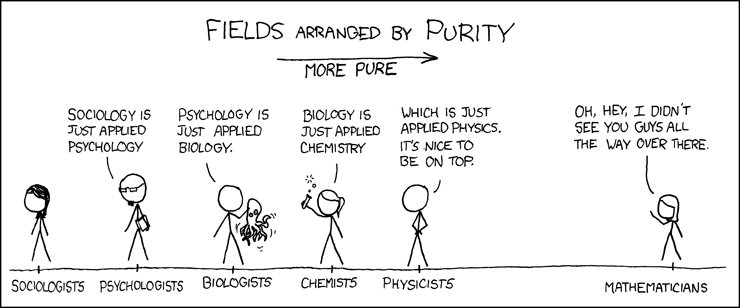
Fortuitous that today's comic on xkcd be about that very subject.
Reply #11 Top
SanChonino,

Hehehe!
Reply #12 Top
Could everybody please note that KFC has been told before that evolution does NOT claim that animals just started existing, does NOT say anything about the beginning of the universe, and does NOT make any statements about whether there is a god (or several gods) or not.
End of quote


We've all noted it hundreds of times by now. Doesn't seem to matter. I guess Satan is erasing that memory location in her brain on a regular basis. He's such a mischievous devil!
Reply #13 Top

I guess Satan is erasing that memory location in her brain on a regular basis.
End of quote


I _hate_ that dude.

:-)
Reply #14 Top

The main thing that creationist get wrong and the reason we have this discussion over and over again is that they see the immutable fact that science cannot consider the supernatural in order to function as being a choice to exclude God.

Dawkins outspoken atheist beliefs reinforce these false conclusions so while I understand his frustration over how he is villainized by religious groups I think he does more harm by not ignoring them. It also doesn't help that atheist beliefs are accepted by the scientific community because they don't conflict, while theist beliefs do conflict and are rightfully ridiculed if they try and merge them with the scientific method. 

Individuals can have a bias but science is pure neutrality and eventually truth is the outcome. Science does not have a secular humanistic agenda, it is a side effect of the only path it can take.

Reply #15 Top

Science does not have a secular humanistic agenda, it is a side effect of the only path it can take.
End of quote


There is not even such a side effect.

Whatever secular humanism is, science does not endorse or deny it.

Whether G-d exists or not is completely immaterial to the question of whether evolution is possible or not (it is) and to the question of whether evolution explains why we have so many different species of plants and animals (it does better than other ideas).

Since Creationists think G-d is relevant in a field that looks for explanations based on reproducible experiments, they came up with "Intelligent Design", which removes G-d from the equation and hence, they think, removes what scientists won't allow.

Well, it doesn't work. Scientists do not object to G-d being in the equation, they object to unfalsifiable elements being in the equation. Whether G-d or a space alien creates the different species does not make a difference to the scientists if neither can be demonstrated at all.

If G-d's influence on nature could be measured and demonstrated, scientists would gladly accept G-d in their equations.

But as it stands G-d and space aliens are in the same bad situation here: they are presumably very powerful but cannot be shown to exist.

Dawkins' atheism has nothing to do with his scientific credentials. Atheists are not better scientists; even though many atheists, having not much else that distinguishes them from total idiots, believe that atheism alone is a scientific qualification of some kind.

Dawkins is villainised by religious groups because he villainises those groups. It's hardly surprising that they, he and the groups, don't like each other. But opposition to his position on religion has nothing to do with whether he is right or not when it comes to evolution.

Evolution will work and will have happened with or without a god. The fruit fly experiment, and many another, that shows how one species can change into two, works the same, regardless of whether G-d watched the scientists or cannot for lack of existence.

And the two populations of fruit flies, incapable of interbreeding with each other, will interbreed only among themselves, hence, over millions of years, create two quite different types of animals. And again that will happen with or without a god.

I can tell you here and now that I think that Richard Dawkins is an arrogant idiot when it comes to religion. But that opinion of mine doesn't make me reject his scientific work. I don't see how it naturally follows that since he is an atheist, I have to oppose whatever results he comes up with in a field that I know has nothing to do with G-d.

Atheist beliefs are just as conflicting with science as theist beliefs. You are wrong there. Scientists do not "accept" atheist beliefs and reject theist beliefs. Scientists do accept neither and reject nothing. Scientists reject gods as irrelevant for their research, but they also reject whatever an atheist can come up with as irrelevant for their research, if it is irrelevant.

My belief in a G-d Who does not interfere with the laws of nature He created does not conflict with the scientific method AT ALL. However, an atheist belief in space aliens (that cannot be seen or heard or perceived in any way at all) DOES conflict with the scientific method.

Deism does not interfere with the scientific method. Scientology does. The Catholic Church's teachings do not interfere with the scientific method. Fundamentalist Protestant Christianity's teaching does.

It has nothing to do with god or no god, but with whether you are willing to allow for a method that simply doesn't take your pet fact that cannot be perceived in nature into account when looking for answers.

Science specifically looks for answers that don't involve things or events that cannot be measured without denying that things or events that cannot be measured exist. They might exist, but they are not part of science.

And let's assume that the Bible is true. And the world was created by G-d 6000 years ago (actually, 5768 years, but who is counting?).

That wouldn't change a thing in science.

Because science would still research the world as it can be perceived. It has NOTHING to do with truth, just with facts.

And "facts", as the name says, are those things and events that were made, not the underlying truth.

The truth was made by G-d too, as one interesting reading of the Bible suggests:

"Bereshit bara elohim et"

The first words of the Bible ("In the beginning created G-d" followed by the preposition for a direct object: "et"). The statement continues with "the heavens and the earth". But the "et" is the part that I was pointed to recently.

The preposition "et" is spelt Aleph Tav, the first and last letter of the Hebrew alphabet (compare English A-Z). The reading here suggests that G-d created the alphabet first.

And what is the alphabet? Another Jewish legend says that the alphabet, since its first letter is Aleph, its middle letter is Mem, and its last letter is Tav, is symbolic for the "truth" ("emet" spelt Aleph Mem Tav). So the first thing G-d created was the truth, and the world is built on it.

(We can continue this game by removing the Aleph and we remain with Mem Tav, the root for death, which suggests something or nothing or perhaps something else or not much. It doesn't matter.)

The point is that THAT just now was religion and not science.

(And if you think that word games are not religion remember that man ("adam", Aleph Dalet Mem) was created out of earth ("adama", Aleph Dalet Mem He). That's a word game too, although one lost in translation, I suppose.)

You will also find that many scientists are Catholics or believing Jews who find no problems with reconciling their (rational) beliefs with the idea of not relying on faith to demonstrate how something works in real life. Similarly many car mechanics go to church but few of them would attempt to fix an engine by replacing the fuel line with a belief that G-d will magically transport the fuel into the engine. (It MIGHT work, I cannot disprove it, but it would be stupid to rely on it and reject the traditional use of physical materials for the connection (or demand that teleportation by G-d be taught in mechanics schools).

Reply #16 Top

Your post confuses me a little, you seem to be arguing my point as if I didn't make it and arguing against things I never said at all. Maybe you not just commenting on what I wrote.

There is not even such a side effect.
End of quote

I see the confusion here, what I mean to say is that you must be secular in following the scientific method and that is falsely seen as an agenda by many. In order for there to be an agenda there has to be a choice.

Atheist beliefs are just as conflicting with science as theist beliefs. You are wrong there. However, an atheist belief in space aliens (that cannot be seen or heard or perceived in any way at all) DOES conflict with the scientific method.
End of quote

No atheism does not conflict in any way with the scientific method. Atheism is nothing more than believing that supernatural gods do not exist, it certainly has nothing to do with a belief in aliens.

I said theist beliefs conflict only when they're applied to the scientific method and just as you said if they're not then there's no problem.

Dawkins is villainised by religious groups because he villainises those groups. It's hardly surprising that they, he and the groups, don't like each other.
End of quote

No it's the other way around, ant-evolution groups choose him as their whipping boy long before he anything at all to say about religion, he has simply responded with more intensity than other scientist. Which is I believe the reason they choose him to vilify in the first place.


Reply #17 Top

Your post confuses me a little, you seem to be arguing my point as if I didn't make it and arguing against things I never said at all. Maybe you not just commenting on what I wrote.
End of quote


And then you address what I said as if it was a direct answer to your points:


I see the confusion here, what I mean to say is that you must be secular in following the scientific method and that is falsely seen as an agenda by many. In order for there to be an agenda there has to be a choice.
End of quote


I think you are mistaken "secular" for "rational". You don't have to be secular to apply the scientific method. You can believe in G-d, if you like, and you can believe that He created the world, and you can even believe that he still interacts with the world. The scientific method is not about removing G-d from the equation. The scientific method is about viewing the world without resorting to supernatural explanations. The scientist can still believe in G-d, he just cannot use a belief as an explanation. (The explanation might still be true, but it wouldn't be scientific.)

Jewish view on evolution in the 1880s:

"Judaism in that case would call upon its adherents to give even greater reverence than ever before to the one, sole God Who, in His boundless creative wisdom and eternal omnipotence, needed to bring into existence no more than one single, amorphous nucleus and one single law of "adaptation and heredity" in order to bring forth, from what seemed chaos but was in fact a very definite order, the infinite variety of species we know today, each with its unique characteristics that sets it apart from all other creatures."

-- Rabbi Samson Raphael Hirsch

Let me clarify that in the 1880s there was not so much evidence available for evolution as today, and the rabbi did not believe that evolution was correct. However, he was perfectly willing to accept what science found and he didn't have to remove G-d from the equation at all to accept scientific research. In fact, he was not only capable of distinguishing between belief and science but he also understood CORRECTLY what the theory of evolution said (as you can see he speaks of a "very definite order" as opposed to "random chance").

The idea that G-d created a world in which evolution was bound to happen to create the variety of species He wanted is not secular. But it absolutely doesn't conflict with studying that world scientifically.

Atheism is also not another word for "rational". You can be a 100% secular atheist and still believe in space aliens like a big loony. In fact, that is where "Intelligent Design" comes from. The Creationists, like you to an extent, have come to the conclusion that science has something to do with G-d (as in being the opposite of it), hence they thought that if they remove G-d and refer to a creator that could be anything, they would have a scientific theory. They don't, for the simple reason that removing G-d from the equation has nothing to do with whether something is scientific or not.

If you use the belief in space alien life creators in your idea, your methods are not scientific. It doesn't matter if you have a god in your idea or not. Any belief in some being we cannot observe is non-scientific (but might still be true).


No it's the other way around, anti-evolution groups choose him as their whipping boy long before he anything at all to say about religion, he has simply responded with more intensity than other scientist. Which is I believe the reason they choose him to vilify in the first place.
End of quote


Well, that wouldn't work. They couldn't have chosen him because he would respond with more intensity if they had not known that he would respond with more intensity.

But to know that he would respond with more intensity when it comes to religion, they must have known about his militant atheism.

Incidentally, Dawkins is also villainised by religious groups who don't reject science at all. Just recently I had a discussion with a Catholic friend of mine and we both thought that Dawkins is an arrogant idiot when it comes to religion. But neither of us reject evolution. So please don't tell me that hostility to Dawkins is merely due to his science.

Some people are prejudiced towards religion. Just a few weeks ago somebody here commented what I wrote on my Web site. On it I wrote that Richard Dawkins is among my favourite authors (which he is). But the gentleman in question couldn't understand that and said that he was "surprised" that I read Dawson. In the same thread he saw me write something about the Bible (a rant on some Hebrew roots, if I recall correctly), so I assume that he couldn't reconcile what he knew about me from the thread and what he knew about me from my Web site. Apparently, I think he thought, people who read the Bible in Hebrew do not read biology books.

Reply #18 Top
BTW, the guy in the video is mistaken.

Most ancient religions were not mutually exclusive, which is why you have so many different gods in history.

I am not an expert on dharmic religions, but I can tell you about Semitic (including Abrahamic) religions.

Most Semitic tribes had city gods or tribe gods. The Phoenician city states and later their colonies in Carthago and Spain had Ba'al. (The word means "master", "lord," or "husband" in modern Hebrew.) Just like the Israelites, the Phoenicians included the name of their G-d in names for their children. Think of Hannibal the famous general. His name means "grace of Ba'al". ("Hanna" means "grace" in Hebrew. The Phoenician language was very similar to the Hebrew language.)

Those tribes interacted and mostly ignored each other's gods. The question for them was not which gods to believe in, but which god to pray to. Phoenicians prayed to Ba'al. Israelites prayed to El. ("El" simply means "god" in Hebrew and most Semitic languages.)

Some Semitic tribes prayed to several gods. All Semitic tribes originally believed that all of these gods probably existed.

Earlier parts of the Bible still refer to the other gods as existing. It is then clarified that Israelites must only pray to one of them. It is also explained that only one of the gods (El) is the creator of the world. At some point El reveals His name.

Israelites then started making fun of those other gods, referring to them as unimportant or not really powerful at all. Ba'al specifically was referred to as the "lord of the flies" (i.e. a lord over something unimportant that pretty much just flies around aimlessly), or, in Hebrew "ba'al zevuv" (the "v" is spelt as a "b"). That's where the modern term "Beelzebub" for the devil comes from. The Israelites didn't think he was evil. They thought he was a joke. (You may count that a an example of mutually exclusive religions, if you like. But it also means that while Ba'al might be a god, El is just so much more powerful that Ba'al might just as well not be.)

(There are also issues about G-d being referred to in the plural in Genesis and theory is that perhaps the story of Genesis is older than monotheism.)

Belief in that one true G-d, the god who created the universe, then became common among some tribes, not only the Israelites. Some of those became incompatible. Mandaeans believe that their god is the god of Adam and Noah but that Abraham prayed to a false god and so do all Jews and Muslims and Christians. Samaritans believe everything the Jews believe up to the Babylonian exile, except they think that the temple was located on a different mountain. ("Mountain" is a bit of an exaggeration anyway. Those things are walkable hills.)

Judaism believes that G-d might send or might have sent prophets to other peoples as well as to Jews.

Zoroastrian Persians, when they conquered the Babylonian empire, found the Jews living in Mesopotamia and after talking to the Jews, discovered that the Jewish god and the Persian god are one and the same. They believed that G-d wanted the Jews to live in the land of Israel and hence sent them back there and funded rebuilding the temple.

There was an incompatibility between Judaism and the Roman and Greek religion. The Israelites wouldn't pray to Greek gods (but didn't care whether they existed or not), but denied that the Roman emperor was a god (because that is incompatible with Biblical teaching).

From the faith of Abraham then came Islam, which specifically points out that adherents of Judaism, Christianity, and Sabianism (could be Zoroastrianism or Mandaeanism) are also following the true G-d and must be allowed to live according to their religions. Islam believes that some things in the Bible are wrong, but Judaism and Islam are hardly "mutually exclusive".

Perhaps he was referring to the last 2000 years or so, when, mostly due to Christianity, the idea of mutually exclusive religions became fashionable?
Reply #19 Top
(There are also issues about G-d being referred to in the plural in Genesis and theory is that perhaps the story of Genesis is older than monotheism.)
End of quote


well actually that's just a story. The truth is and can be seen in other parts of scripture that God in the plural is speaking of the trinity. Because if you go to John 1 you see an explanation. "In the beginning was the word and the word became flesh and dwelt among us." We see this thought played out all thru the scriptures both OT and NT that Jesus was part of the creative process.
Reply #21 Top

And then you address what I said as if it was a direct answer to your points:
End of quote

I took a chance :)

I think you are mistaken "secular" for "rational". You don't have to be secular to apply the scientific method. You can believe in G-d, if you like, and you can believe that He created the world, and you can even believe that he still interacts with the world. The scientific method is not about removing G-d from the equation. The scientific method is about viewing the world without resorting to supernatural explanations. The scientist can still believe in G-d, he just cannot use a belief as an explanation. (The explanation might still be true, but it wouldn't be scientific.)
End of quote

Again we're saying he same thing.

"I see the confusion here, what I mean to say is that you must be secular in following the scientific method"

Secular IN following the scientific method not secular TO follow the scientific method. God out of the scientific method. 

If you use the belief in space alien life creators in your idea, your methods are not scientific. It doesn't matter if you have a god in your idea or not. Any belief in some being we cannot observe is non-scientific (but might still be true).
End of quote

Never said it was, however new information could change that. The discovery of a digital signature in our DNA or them coming back to check up on us ;)

Perhaps he was referring to the last 2000 years or so, when, mostly due to Christianity, the idea of mutually exclusive religions became fashionable?
End of quote

Perhaps; Thank you for the very interesting and informative post BTW.


Reply #22 Top

Thank you for the very interesting and informative post BTW.
End of quote


Thanks, I always try to explain what I can.

Needless to say, "Jesus" is just about the only character who isn't even implied to exist in any of the old legends, Biblical or outside Jewish scripture. A messiah was expected (and still is), but what that Messiah would do was explained in detail and the historical Jesus did none of the things. (Performing miracles was not part of what the messiah was supposed to do.)

And the Semitic pantheon of many gods is also not symbolic for a "trinity".

In fact, and this is perhaps ironic, Hebrew has a specific plural form for plurals that appear as a set. This is usually called a "dual tense" because it most often applies to pairs: "yadaim" (YDYYM) = "hands", "einaim" (`YNYYM) = "eyes". But it also applies to larger groups, if they belong as a set. The four legs of a dog are "reglaim" (RGLYYM).

But "elohim" is a normal plural, not a dual (i.e. not a plural describing a set). If "elohim" and other references to more than one god referred to a trinity that is also one (and it would have to be a trinity that is also one, I'll explain in a second), I would assume the word to be "elohaim" instead of "elohim", i.e. 'LHYYM instead of 'LHYM.

It seems odd to me that somebody, G-d or any human author would try to hide this "trinity" message by using a method that specifically rules it out, even though a method that would allow for it was available as an alternative.

What the Bible is very specific about, despite many references to a god plural, is that the Jewish god is _ONE_ god. In fact, "adonai eloheynu, adonai echad" has been the most common prayer statement in Judaism for 3000 years. "Adonai" is a plural of "my lord", here representing a polite form of the singular and used as a name for G-d: "Adonai is our god, Adonai is one".

So while it might be true that there is meant to be a trinity, I think it hardly likely that the Bible text, specifically written to allow for ONE and MANY, is supposed to mean that there is a THREE involved