




Zoo's Amazing Animal Feature 4
 JoeUser Forums
Well, here we are for another edition of my highly anticipated series. (Well, a man can dream, eh?  )
)
Dr Guy suggested the...
Virginia Opossum (AKA possum) Didelphis virginiana
From the family Didelphidae which includes all Western Hemisphere opossums.


Observe the majestic beauty.
Physical Characteristics:
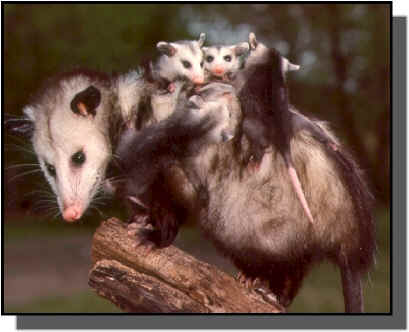
Length can vary between 14-22in (~55 cm) and weight between 2-11lbs (0.8~5kg). So there's a lot variation. Their fur is long with a thick undercoat. Color can range from whitish to blackish brown. Ears are hairless and black. Their cheeks are white, giving a slight masked appearance. The tail is primarily naked, scaly, and bicolored: the base is dark, usually black and the rest is whitish. The tail is also fully prehensile enabling the opossum to use it as an extra limb when climbing. Adults cannot support themselves by tails alone, though the young can do it temporarily.

It is a marsupial, the only one native to North America.
The back feet possess opposable "thumbs" (it's actually a specialized hallux- "a big toe"), making for a unique and unmistakable footprint.

Males have a bifurcated penis, shaped like a two pronged fork. The female possess a matching vagina. In fact, their Latin name Didelphis meaning double-wombed
Habitat:
North America from subtropical/tropical Mexico all the way to Southwestern Canada. The west coast and eastern half of the US. Central America all the way south to Costa Rica. Originally it was only found in the Eastern US, though was introduced into the West during the Great Depression, possibly as a food source. Urban encroachment has also allowed it to move pretty much anywhere because food is no longer an issue when living around people.
Tropical and temperate forests, farmland, and urban centers. Pretty much anywhere they can find food, water, and a place to sleep. They can live anywhere from pristine wilderness habitats to a city dump.
Diet:
Omnivorous, it has a very broad diet and is extremely opportunistic. Their diet mainly consists of carrion. However, they will consume prey that is easily caught such as insects, frogs, birds, snakes, small mammals, and earthworms. Fruits, both fresh and rotten, are also fair game for opossum consumption.
In urban areas, trash and pet food are fair game for a meal.
Behavior:
Nocturnal and solitary. Nomadic, going to wherever conditions are most favorable. They are able to climb very well, but regularly roam around on the ground to feed. They roost during the day in branches, tree hollows, caves, leaf litter, and even soil. Also they take advantage of human infrastructure: attics, barns, basements, anywhere they can fit.
When threatened, the opossum will growl deeply as the threat becomes more urgent, it will then either run or deploy it's famous technique- playing possum. The opossum feigns death in a very realistic display; the mouth gapes, the muscles freeze, and a pungent musk is excreted to mimic the smell of rot. This process is entirely reactionary and not a conscious decision. A possum in this state can be poked, prodded, and even moved with little fear of retaliation. It can a few minutes up to a couple hours for the opossum to regain consciousness and wander off.
When reproduction time rolls around, males will make a clicking "smack" sound with the side of their mouth when looking for females, and sometimes the female responds with the same noise. The reproductive season runs from January through July.
A female will construct a nest with leaf litter and vegetation with the help of her tail. The gestation period is only 13 days in which as many as 21 young are developed. There are only 13 teats in the pouch and rarely are all occupied at once, so the only the first ones into the pouch will have a chance at survival. They are very tiny when born, about the size of a dime. The mother will lick a trail to her pouch for the young to follow, like most other marsupials.
 Opossum infant only a few days old next to a dime.
Average litter size is around 8 young. The young will suckle for about two and a half months inside the mother's pouch. At around 55-70 days, their eyes open and they will venture outside and hang onto the mother's back. If one gets separated it makes sneezing noises to call it's mother back. At around 5 months, the young become independent and set off into the world. Average lifespan is 2-3 years in the wild, up to 4 years in captivity. They are surprisingly short lived for their size and can be observed aging very quickly.
Interesting Facts:
Opossums have more teeth than any other North American land mammal (50).
The Virginia Opossum is the original animal named "opossum". The word comes from Algonquian "wapathemwa". The plural of opossum is opossums.
Rabies infection is very low in opossums due to a low blood temperature. (94-97º F/ 34-36ºC)
They have a robust immune system and are highly resistant to bites from rattlesnakes, cottonmouths, and other pit vipers.
The opossum was a favorite game animal in the United States, and in particular the southern regions which have a large body of recipes and folklore relating to the opossum. Opossum was once widely consumed in the United States where available as evidenced by recipes in older editions of The Joy of Cooking.
I had a personal experience with the opossum. My dog must've scared the crap out of one, it froze, and she decided to bring it back. It had a good coating of drool on it, but seemed to be okay. I picked it up and put it in a field behind my house. I checked back later and it was gone, so I assume it woke up and wandered off.
Oh and remember...
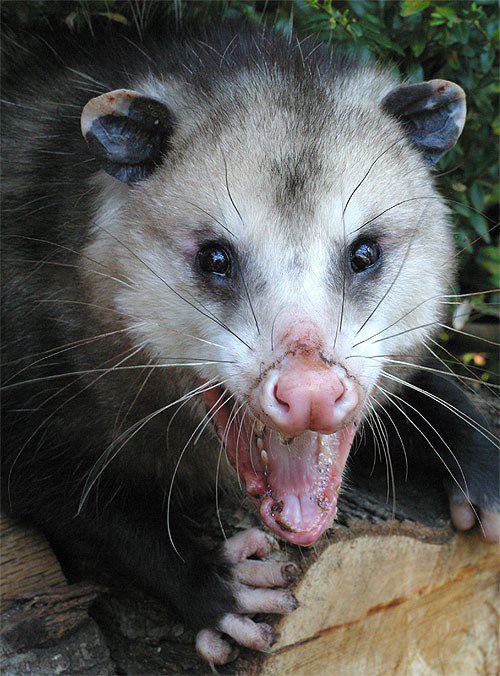
The opossum loves you. 
~Zoo
 WinCustomize Forums
 Stardock Forums
 I don't know if the practice is popular anymore...but I reckon if you were hungry back in the 1800s you'd give Possum Pot Pie a chance.